Türkiye · Central Anatolia
Study in Eskişehir: universities, costs and careers for international students
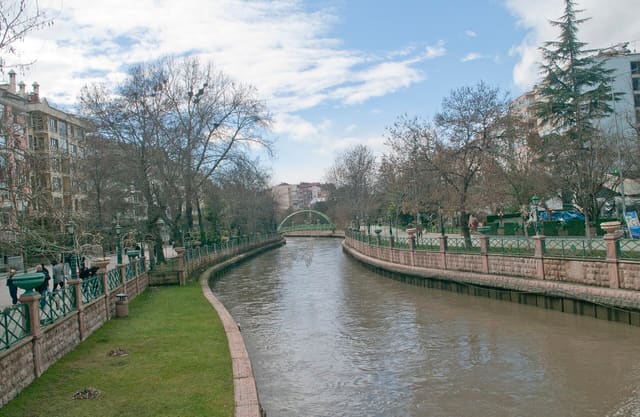
Eskişehir is the closest thing Türkiye has to a European university town. A large share of the population is a student, the tram runs from campus to the centre, the Porsuk river cuts through the middle and the whole city is organised around being young. It is also Türkiye’s aviation and rail engineering centre, which makes it a specific rather than a general choice. Here is what to weigh.
Why Eskişehir
Before the detail, the snapshot - what you actually get by studying here.
- A genuine student city: three universities and well over 100,000 students in a city of around 900,000, so prices, transport and nightlife are all built around them
- Anadolu University: one of the largest universities in the world by enrolment, and home to Türkiye’s best-known civil aviation faculty with its own airport and training fleet
- Eskişehir Technical University: the engineering and science half of the old Anadolu, focused on aeronautics, materials and computer engineering
- Türkiye’s aviation and rail industry sits here - TEI builds jet engines with GE Aerospace, and TÜLOMSAŞ builds locomotives
Universities & popular courses
Three institutions with clearly separated roles - pick the one that owns your subject.
- Anadolu University: civil aviation management, pilot training, communication sciences, fine arts, education and one of the biggest open-education systems anywhere
- Eskişehir Technical University (ESTÜ): aeronautical, materials, chemical, civil, industrial and computer engineering, plus earth and space sciences, with English-medium options
- Eskişehir Osmangazi University: medicine, dentistry, engineering, agriculture and a large teaching hospital
- Aviation is the local speciality worth naming: pilot training, air traffic control, avionics maintenance and aviation management are all taught here, with the aircraft on site
- Curriculum: four-year bachelor’s, one-to-two-year master’s, and preparatory language years where the programme requires it
Career prospects & ROI
The aviation and rail cluster is the reason to come - outside it, Eskişehir is a place to study cheaply and then move.
- Industry connections: TEI (TUSAŞ Engine Industries, a joint venture with GE Aerospace) builds and maintains jet engines here and takes engineering interns; TÜLOMSAŞ builds rail stock; large food and appliance plants sit nearby
- Anadolu’s aviation faculty feeds graduates into Turkish Airlines, Pegasus and the wider Turkish aviation sector, one of the fastest-growing in the world
- Pilot training is expensive everywhere, but Anadolu is dramatically cheaper than an EU flight school - check how your own country and target employers recognise the licence before committing
- Work while you study: the standard national rules; student work in Eskişehir is mostly in cafés, tutoring and the university itself
- Erasmus+ exchange is well established at all three universities
Cost of living in Eskişehir
Estimates for the 2026 academic yearA student in Eskişehir should budget around 420 € a month. The heaviest line by far is rent: a room in a shared flat goes for about 130 €, and most land between 95 € and 190 €.
- Room in a shared flat usually 95 € – 190 €
- 130 €
- Food and groceries
- 150 €
- Student travel pass
- 12 €
- Health insurance
- 18 €
- Phone, internet, electricity
- 50 €
- Books, sport, going out
- 60 €
- Monthly total
- 420 €
Ranked 3 of 8 on cost among the cities we cover in Türkiye, cheapest first.
Cheapest on our list: Karabük, at about 400 € a month. →What things cost here, against the EU
Across the whole shopping basket Türkiye sits at 46.8, where the EU average is 100 (2024).
EU average = 100
Consumer prices rose 34.9% over 2025.
Where these numbers come from
The monthly budget is our own estimate, compiled from what student unions, universities and national student services publish. Use it to plan with — it is not a quote.
The price levels, inflation and rent figures are published statistics: Eurostat purchasing power parities and, for German states, the Federal Statistical Office (Destatis).
Success stories
Students who crossed the bridge

“I wasted a year trying alone. After the strategy call I knew exactly which documents I was missing - three months later I had my admission.”Read full story →

“They prepared my visa file so well the interview took ten minutes. They even helped my parents understand the blocked account.”Read full story →

“With the VIP pack I arrived in Finland with my room, bank account and even my airport pickup organised. I just had to study.”Read full story →
What it costs
Student-city prices - among the cheapest in this guide after Karabük.
- Tuition at the three state universities for international students: roughly USD 300-1,800 a year, with medicine and pilot training in a much higher bracket
- Living costs: budget EUR 300-450 a month. Shared flats near the campuses run EUR 130-250
- Transport: two tram lines connect the campuses to the centre and the station, and a student card makes it near-free
- The city is on the Ankara-Istanbul high-speed rail line, so both of the big student cities are a couple of hours away
- Türkiye Bursları covers all three universities
Life, safety & culture
Young, liberal, walkable and organised around students - the easiest small city on this list to enjoy.
- Eskişehir has a reputation across Türkiye as the most relaxed and progressive of the inland cities, largely because of the student population
- The Porsuk riverfront, the Odunpazarı old quarter with its restored Ottoman houses and a dense café culture carry the social life
- Language: Turkish runs daily life, but the student population means more English than in a comparable non-university city
- Safety: low crime, well-lit student districts and a compact centre you can walk across
- Healthcare: Osmangazi University’s teaching hospital serves the region, and SGK cover applies as elsewhere
How to apply & the bureaucracy
Standard Turkish admissions, with aviation programmes carrying extra medical and licensing requirements.
- Bachelor’s: apply directly to each university between roughly June and August, on a national certificate, SAT or the university’s YÖS exam
- Pilot training and air traffic control have additional aviation medical examinations and, in some cases, interviews - start those early, because they can disqualify you after admission
- Master’s: direct applications for September and February intakes with transcripts, references and a statement of purpose
- English proficiency: IELTS 6.0 or equivalent for English-medium programmes; Turkish-medium programmes require a TÖMER C1 certificate
- After acceptance: student visa at the Turkish embassy, then the residence permit at the Eskişehir migration office within 30 days of arrival
Read these guides next
Want UniBridgeEurope to do all of this for you?
We take African students from first choice to arrival in Europe: university shortlist, applications, student visa, flights, bank account and housing. Start with a €99 strategy call, or choose the package that comes with an admission guarantee.