Italy · Emilia-Romagna
Study in Bologna: universities, costs and careers for international students
Bologna is the closest thing Italy has to a university town: a city of about 390,000 people with roughly 90,000 students in it, almost all of them at one institution - the University of Bologna, founded in 1088 and the oldest in continuous operation anywhere. That concentration is the point. Housing, transport, nightlife and the city’s politics are organised around students, the Emilia-Romagna regional grants (ER.GO) are the most generous in the country, and the surrounding region - Motor Valley, packaging machinery, food processing - is one of Europe’s densest manufacturing clusters. The catch is a rental market squeezed by exactly that student concentration. Here is what to weigh.
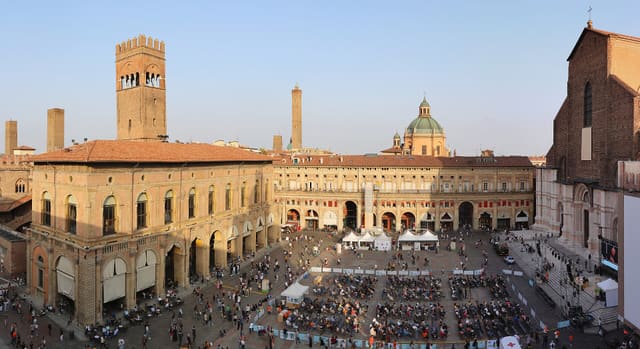
Why Bologna
Before the detail, the snapshot - what you actually get by studying in Italy’s student city.
- The University of Bologna (UniBo) is the oldest university in the world and usually the highest-placed Italian university in the international rankings, with more than 90,000 students and one of the largest English-taught offers in the country
- A genuine student town: roughly one resident in four is a student, so the city runs on student prices, student housing and student hours in a way Milan and Rome do not
- Emilia-Romagna’s ER.GO grants are the most generous regional right-to-study awards in Italy - a full award covers fees, a residence place, canteen meals and a cash instalment
- The Bologna Tecnopolo hosts the ECMWF weather-forecasting data centre and the Leonardo supercomputer, one of the fastest in Europe - which is why the AI and data-science offer here is unusually strong
- A multi-campus university: Forlì (international relations, aerospace), Cesena (biomedical and computer engineering), Rimini (tourism, wellness) and Ravenna (cultural heritage, environmental sciences) run under the same degree and the same fees
- Central on the national rail network - Milan in an hour, Florence in 35 minutes, Rome in two hours - with Bologna Marconi airport covering Europe and one-stop routes to west and east Africa
Universities & popular courses
Bologna is effectively a one-university city, but that university is large enough to cover almost everything. Check the language of instruction on each programme page.
- Engineering and computing: automation, mechanical, biomedical, electronic and telecommunications engineering, computer science and Artificial Intelligence - the AI master’s is taught in English and sits next to the Tecnopolo supercomputing centre
- Economics and management: the English-taught Economics and Finance, Business and Economics, and Innovation and Organization of Culture and the Arts programmes, plus a large economics faculty on the Rimini and Forlì campuses
- Medicine and health: Medicine and Surgery in English at the Bologna medical school, alongside pharmacy, biotechnology and the health professions
- International relations, law and the humanities: the Forlì campus runs international relations and interpreting, and Bologna has one of the strongest classics, history and cultural-heritage faculties in Europe. The Johns Hopkins SAIS Europe campus is also in the city
- Also in the region: the University of Modena and Reggio Emilia, the University of Ferrara and the University of Parma are all within an hour by train, which widens the choice without changing the ER.GO grant rules
- Curriculum: a bachelor’s (laurea triennale) runs three years and a master’s (laurea magistrale) two; medicine, pharmacy, veterinary science, law and architecture are single-cycle degrees of five to six years
- Most popular with international students: artificial intelligence and computer engineering, automation and mechanical engineering, economics and finance, international relations, and medicine in English
Career prospects & ROI
The city is small, but the region around it is one of the richest industrial areas in Europe - and it hires engineers.
- Motor Valley: Ferrari and the Formula 1 operation at Maranello, Lamborghini at Sant’Agata, Ducati in Bologna itself, Maserati and Dallara - all within an hour, and all recruiting mechanical, automotive and materials engineers straight out of UniBo
- Packaging Valley: IMA, Coesia, Marchesini and GD build a large share of the world’s packaging and pharmaceutical machinery from around Bologna, and hire automation and mechatronics graduates in volume
- Data and research: the ECMWF data centre, the Leonardo EuroHPC supercomputer, CINECA and the CNR institutes make Bologna Italy’s computing hub, with research and industry roles attached
- Food and agri-tech: Emilia-Romagna is the Parmigiano, Parma ham and Barilla region, with a food-technology and agri-business sector that recruits food scientists and process engineers
- Work while you study: the student residence permit allows up to 20 hours a week, capped at 1,040 hours a year. In a city this student-heavy, tutoring, catering and events work is easy to find
- After you graduate: the permesso di soggiorno per attesa occupazione gives up to 12 months to find work or start a business after an Italian degree; Emilia-Romagna has the lowest graduate unemployment of any large Italian region
- The honest trade-off: outside engineering and computing, Bologna itself is a small job market, and many graduates in the humanities or economics move to Milan afterwards
Cost of living in Bologna
Estimates for the 2026 academic yearA student in Bologna should budget around 995 € a month. The heaviest line by far is rent: a room in a shared flat goes for about 480 €, and most land between 390 € and 620 €.
- Room in a shared flat usually 390 € – 620 €
- 480 €
- Food and groceries
- 250 €
- Student travel pass
- 25 €
- Health insurance
- 50 €
- Phone, internet, electricity
- 80 €
- Books, sport, going out
- 110 €
- Monthly total
- 995 €
Ranked 2 of 4 on cost among the cities we cover in Italy, cheapest first.
Cheapest on our list: Turin, at about 935 € a month. →What things cost here, against the EU
Across the whole shopping basket Italy sits at 98.1, where the EU average is 100 (2024).
EU average = 100
Consumer prices rose 1.7% over 2025.
Where these numbers come from
The monthly budget is our own estimate, compiled from what student unions, universities and national student services publish. Use it to plan with — it is not a quote.
The price levels, inflation and rent figures are published statistics: Eurostat purchasing power parities and, for German states, the Federal Statistical Office (Destatis).
Success stories
Students who crossed the bridge

“I wasted a year trying alone. After the strategy call I knew exactly which documents I was missing - three months later I had my admission.”Read full story →

“They prepared my visa file so well the interview took ten minutes. They even helped my parents understand the blocked account.”Read full story →

“With the VIP pack I arrived in Finland with my room, bank account and even my airport pickup organised. I just had to study.”Read full story →
What it costs
The fees are ISEE-scaled like everywhere in public Italy, the regional grants are the best in the country, and the rent is the thing that will surprise you.
- Public tuition is means-tested through the ISEE parificato: below the no-tax threshold - around EUR 23,000-27,000 of assessed income at UniBo - you pay only the regional tax and stamp duty, roughly EUR 160-200 a year. The full rate tops out near EUR 3,000-3,500
- ER.GO, the Emilia-Romagna right-to-study agency, is the reason many students choose this region: a full award covers the tuition waiver, a place in a student residence or a housing contribution, canteen meals and a cash instalment paid across the year. It is means-tested on the same ISEE and is a separate application, usually due in late summer
- Living costs: budget EUR 750-1,000 a month. A room in a shared flat runs EUR 400-600 - high for a city this size, precisely because of the student numbers - and an ER.GO residence place costs far less
- Transport is cheap and mostly unnecessary: the historic centre is walkable end to end under its porticoes, and a student bus pass runs around EUR 200-300 a year
- Other funding: UniBo’s own study grants and tuition waivers for international students (a fixed number awarded on merit and need each year), MAECI Italian government scholarships, and Erasmus Mundus joint master’s degrees
- One-off costs: the visa fee, the EUR 16 revenue stamp and roughly EUR 70-120 for the residence-permit kit, health cover for the whole stay, and a deposit of two to three months’ rent
- The visa also asks for proof of means for the year - a bank statement or a scholarship award letter in your name
Life, safety & culture
The most student-shaped city in Italy - small, walkable, political, and cheap to enjoy once you have a room.
- Language: UniBo has one of the largest English-taught catalogues in Italy, but the city itself runs in Italian. The university language centre (CLA) runs free Italian courses - take one immediately
- Bologna is a safe, compact city; the realistic risks are bike theft, pickpocketing around the station and the ordinary consequences of a very late nightlife, not violent crime
- Healthcare: register with the SSN (the annual student contribution rose sharply in 2024 - check the current figure) or buy private cover; the Sant’Orsola teaching hospital is one of the largest in the country
- Housing is the single hardest part of studying in Bologna. Demand outstrips supply every autumn - apply for an ER.GO residence place as early as you can, start searching in June, and never send a deposit for a flat you have not seen
- Student life is the city’s main industry: the Zona Universitaria around Via Zamboni, cheap osterie, a strong live-music tradition, and a political and activist culture that has defined the city for decades
- A visibly international student body, with African, South Asian, Middle Eastern and Latin American communities and an Erasmus population that refreshes every semester - but a small city means fewer diaspora networks than Milan or Rome
How to apply & the bureaucracy
One university, one set of deadlines - which makes Bologna simpler to apply to than Milan or Rome.
- Apply through UniBo’s Studenti Online portal. The international-student call for most English-taught programmes opens in the autumn and closes in the spring, well before the Italian-taught rounds, so check the specific bando for your degree
- Pre-enrol on the Universitaly portal for one university and one programme - the study visa is not issued without it, and the deadline usually falls in early summer
- Entrance requirements: many degrees use the TOLC test run by CISIA, which can be sat online from home; English-taught medicine uses the IMAT in September; several master’s degrees assess on transcripts and a motivation letter alone
- Language proficiency: English-taught programmes typically ask for IELTS 6.0-6.5 or TOEFL iBT 78-90; Italian-taught ones ask for B2 Italian
- Documents: school-leaving certificate or bachelor’s degree with transcripts, passport, motivation letter and references, plus a CIMEA Statement of Comparability or a Dichiarazione di Valore. Begin this months ahead - it is the usual bottleneck
- After acceptance, apply for the type D student visa, file for the permesso di soggiorno within eight working days of arrival, get a codice fiscale on day one, and apply for the ER.GO grant and residence place in the same period - the deadlines overlap
Read these guides next
Want UniBridgeEurope to do all of this for you?
We take African students from first choice to arrival in Europe: university shortlist, applications, student visa, flights, bank account and housing. Start with a €99 strategy call, or choose the package that comes with an admission guarantee.