Poland · Lower Silesia
Study in Wroclaw in English: universities, costs and careers for international students
Wroclaw is Poland’s fourth-largest city and arguably its most international. Roughly one in six residents is a student, the city has one of the highest shares of foreign residents in the country, and its universities feed a dense cluster of IT, electronics and manufacturing employers. It sits two hours from the German and Czech borders, which shapes both the job market and the weekend travel. Costs are meaningfully lower than Warsaw. Here is what to weigh.
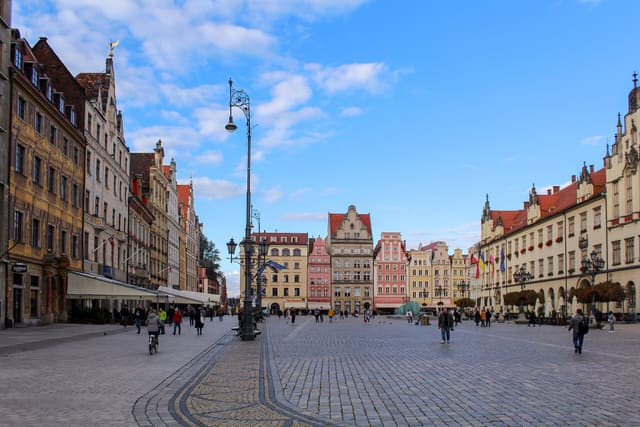
Why Wroclaw
Before the detail, the snapshot - what you actually get by studying in Lower Silesia’s capital.
- The University of Wroclaw: a large research university with a strong international profile in law, political science, biotechnology and the sciences
- Wroclaw University of Science and Technology: one of Poland’s top three technical universities, with a wide English-taught engineering offer
- Wroclaw University of Economics and Business: a leading Polish school for finance, management and logistics, with English-language degrees
- A dense employer cluster - IT, electronics, automotive, banking back offices - within tram distance of the campuses
Universities & English-taught programmes
Look past the overall ranking to subject strength and the language of instruction - that is what decides your fit.
- Wroclaw University of Science and Technology teaches full English-language bachelor’s and master’s in computer science, electronics, mechanical engineering, architecture and renewable energy
- The University of Wroclaw runs English-taught programmes in international relations, European studies, business management, chemistry and biotechnology
- Wroclaw University of Economics and Business offers English-taught bachelor’s and master’s in international business, finance and logistics
- Wroclaw Medical University runs an English Division medicine and dentistry programme for international students
- Curriculum flexibility: a large Erasmus+ network and double-degree agreements with German, French and Spanish partner universities
Career prospects & ROI
Wroclaw is one of Poland’s strongest engineering and IT job markets, and the sector hires in English.
- Industry connections: Nokia, Google, IBM, UBS, Capgemini, Volvo, LG Energy Solution, Amazon and Dolby all run large Wroclaw sites and recruit engineering interns locally
- Wroclaw is the third-largest business-services location in Poland, with tens of thousands of English-language roles in IT, finance and R&D
- Students on a Polish study visa or residence permit may work without a work permit and without a weekly hour cap - internships during term are normal
- Post-study work: a temporary residence permit of up to nine months to look for a job or start a business after graduating
- Engineering and IT graduate salaries are close to Warsaw levels while rents are roughly 25% lower - one of the best cost-to-salary ratios in Poland
Cost of living in Wroclaw
Estimates for the 2026 academic yearA student in Wroclaw should budget around 682 € a month. The heaviest line by far is rent: a room in a shared flat goes for about 300 €, and most land between 240 € and 400 €.
- Room in a shared flat usually 240 € – 400 €
- 300 €
- Food and groceries
- 200 €
- Student travel pass
- 12 €
- Health insurance
- 25 €
- Phone, internet, electricity
- 60 €
- Books, sport, going out
- 85 €
- Monthly total
- 682 €
Ranked 5 of 8 on cost among the cities we cover in Poland, cheapest first.
Cheapest on our list: Lodz, at about 632 € a month. →What things cost here, against the EU
Across the whole shopping basket Poland sits at 70.2, where the EU average is 100 (2024).
EU average = 100
Consumer prices rose 3.3% over 2025.
Where these numbers come from
The monthly budget is our own estimate, compiled from what student unions, universities and national student services publish. Use it to plan with — it is not a quote.
The price levels, inflation and rent figures are published statistics: Eurostat purchasing power parities and, for German states, the Federal Statistical Office (Destatis).
Success stories
Students who crossed the bridge

“I wasted a year trying alone. After the strategy call I knew exactly which documents I was missing - three months later I had my admission.”Read full story →

“They prepared my visa file so well the interview took ten minutes. They even helped my parents understand the blocked account.”Read full story →

“With the VIP pack I arrived in Finland with my room, bank account and even my airport pickup organised. I just had to study.”Read full story →
What it costs
A big-city job market on a mid-sized city budget.
- Tuition for non-EU students: roughly €2,000-€4,000 a year for English-taught bachelor’s and master’s; English-language medicine and dentistry are far higher, around €12,000-€15,000 a year
- Living costs: budget PLN 2,800-3,800 a month (about €650-€880), with dormitory places from roughly PLN 500-800 a month
- Proof of funds for the visa: the legal minimum is around PLN 776 a month for each month of stay plus return travel - budget realistically above it
- Health insurance: voluntary NFZ cover for students is about PLN 55-60 a month; travel or private insurance covers the visa application
- Scholarships: NAWA programmes for developing-country students, university tuition discounts for high grades, and Erasmus+ grants for exchange semesters
Life, safety & culture
A river city with a hundred bridges, a huge student population and a genuinely international feel.
- Daily language is Polish, but Wroclaw is one of the most English-friendly Polish cities thanks to its student and expat population; universities run free Polish courses
- A dense tram network with a discounted student pass; the campuses, the Rynek and the dormitories are all within a short ride
- Low crime, good student healthcare through NFZ, and a compact centre that is easy to navigate in your first weeks
- One of Poland’s most active international student scenes, with large Erasmus, African and Indian student communities
How to apply & the bureaucracy
Direct admission through each university’s portal - and paperwork that takes longer than the application itself.
- Apply through the university’s own online system; the October intake usually closes between May and July, with a smaller February intake on some programmes
- English proficiency: IELTS 6.0-6.5 or TOEFL iBT 79-90, or a secondary certificate taught in English
- Your secondary certificate must be legalised or apostilled and translated by a sworn translator; engineering programmes usually want mathematics and physics results
- After admission, apply for the national D student visa with proof of funds, insurance and accommodation, then apply for a residence card after arrival
Read these guides next
Want UniBridgeEurope to do all of this for you?
We take African students from first choice to arrival in Europe: university shortlist, applications, student visa, flights, bank account and housing. Start with a €99 strategy call, or choose the package that comes with an admission guarantee.