Hungary · Central Hungary
Study in Budapest: universities, costs and careers for international students
Almost everything about studying in Hungary is concentrated in Budapest: the oldest and largest university (ELTE), the school that trains most of the country’s engineers (BME), the medical faculty international students have been flying in for since the 1980s (Semmelweis), and a services and technology job market that runs in English rather than Hungarian. Living costs are among the lowest of any EU capital and the Stipendium Hungaricum scholarship funds thousands of places a year. The trade-offs are that rent has risen faster here than anywhere else in the country, and that outside the international offices daily life runs in Hungarian - a language related to nothing you have studied. Here is what to weigh.
Universities in Budapest
4 universities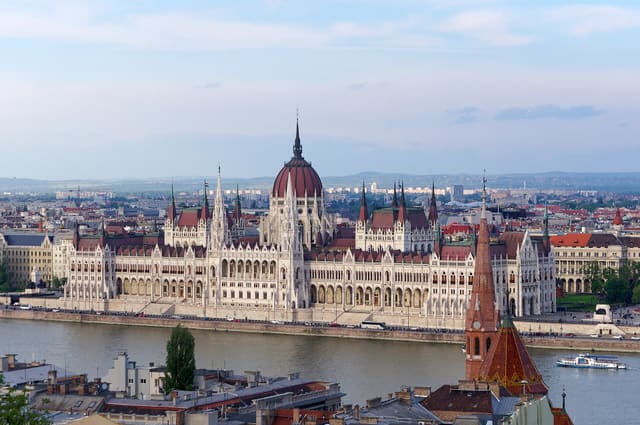
Why Budapest
Before the detail, the snapshot - what you actually get by studying in the Hungarian capital.
- Four of Hungary’s best-known universities inside one city - Eötvös Loránd University (ELTE), the Budapest University of Technology and Economics (BME), Semmelweis University and Corvinus - so almost any subject you can name is taught somewhere on the metro network
- The country’s only deep graduate job market: most of Hungary’s shared-service centres, regional headquarters and technology employers are here, and a great many of them work in English
- Semmelweis has taught medicine and dentistry to international students in German and English for decades, which is why Budapest has one of the largest foreign medical-student populations in Europe
- Stipendium Hungaricum, the Hungarian government scholarship, places most of its funded students here - tuition, a monthly stipend, accommodation support and health insurance, for students from more than 90 partner countries
- A BKK student pass costs around HUF 4,500 a month and covers the whole metro, tram, bus and suburban rail network; the M1 line under Andrássy út is the oldest underground railway on the European mainland
- Budapest Ferenc Liszt airport reaches most of Europe on low-cost carriers, with one-stop routes to Lagos, Accra, Nairobi, Addis Ababa, Cairo and Casablanca
Universities & popular courses
Check the language of instruction on the individual programme page. Hungary teaches a large share of its degrees in Hungarian and concentrates the English-taught offer in medicine, engineering, IT and business.
- Eötvös Loránd University (ELTE): founded in 1635 and usually the highest-placed Hungarian university in the international rankings - strong in mathematics, physics, computer science, psychology, law and the humanities, with English-taught bachelor’s and master’s across the science faculty
- Budapest University of Technology and Economics (BME): the country’s main engineering school, tracing its origins to 1782 - mechanical, electrical, civil and chemical engineering, architecture and computer science, with a long list of English-taught master’s and a few English bachelor’s tracks
- Semmelweis University: General Medicine, Dentistry and Pharmacy in English, six years for medicine, taught across a clinical network spread through the city. This is the expensive route - budget in the region of USD 10,000 a semester for medicine and dentistry - but the degree is recognised across the EU
- Corvinus University of Budapest: economics, business administration, international relations and data analytics - the best-known business school in the country, with a growing English-taught undergraduate offer
- Also here: the Hungarian University of Agriculture and Life Sciences (MATE) for agriculture, food science and environmental engineering, Óbuda University for applied engineering and IT, and Budapest Metropolitan University for design, media and business
- Curriculum: a Hungarian bachelor’s (alapképzés) runs three to four years and a master’s (mesterképzés) two, while medicine, dentistry, pharmacy, veterinary science and law are single-tier programmes of five to six years
- Most popular with international students: general medicine, dentistry, pharmacy, computer science and software engineering, business administration, international relations and civil and mechanical engineering
Career prospects & ROI
Budapest is the only city in Hungary with a graduate market deep enough to absorb a large international intake - and much of it hires in English.
- Industry connections: Morgan Stanley, Citi, BlackRock, Deutsche Telekom, Vodafone, BT, IBM, SAP, Ericsson, Nokia, Bosch, Continental, Diageo and BP all run business-service or engineering centres in Budapest, alongside a home-grown technology scene
- Those centres exist because they need languages. English plus French, Portuguese, Arabic or Swahili is itself a hiring qualification here in a way it is not in most of Europe
- Work while you study: a Hungarian student residence permit allows up to 30 hours a week of paid work during term and full-time work for up to 90 days outside it, with no separate work permit. Confirm the current limits with the National Directorate-General for Aliens Policing before you rely on them
- After you graduate: Hungary issues a job-search and entrepreneurship residence permit valid for up to nine months to graduates of Hungarian higher education. It cannot be extended, so file it at least 15 days before your student permit expires and treat the nine months as a hard deadline
- Hungary is a full EU and Schengen member: the degree is recognised across the bloc, Erasmus+ exchange semesters are open to you, and years of legal residence count towards permanent residence
- The honest trade-off: Hungarian salaries are low by Western European standards and the forint has been volatile. The return comes from a cheap EU degree and EU-wide mobility, not from a large first pay cheque in Budapest
Cost of living in Budapest
Estimates for the 2026 academic yearA student in Budapest should budget around 740 € a month. The heaviest line by far is rent: a room in a shared flat goes for about 350 €, and most land between 270 € and 460 €.
- Room in a shared flat usually 270 € – 460 €
- 350 €
- Food and groceries
- 200 €
- Student travel pass
- 10 €
- Health insurance
- 30 €
- Phone, internet, electricity
- 70 €
- Books, sport, going out
- 80 €
- Monthly total
- 740 €
Ranked 4 of 4 on cost among the cities we cover in Hungary, cheapest first.
Cheapest on our list: Pécs, at about 610 € a month. →What things cost here, against the EU
Across the whole shopping basket Hungary sits at 68.3, where the EU average is 100 (2024).
EU average = 100
Consumer prices rose 4.4% over 2025.
Where these numbers come from
The monthly budget is our own estimate, compiled from what student unions, universities and national student services publish. Use it to plan with — it is not a quote.
The price levels, inflation and rent figures are published statistics: Eurostat purchasing power parities and, for German states, the Federal Statistical Office (Destatis).
Success stories
Students who crossed the bridge

“I wasted a year trying alone. After the strategy call I knew exactly which documents I was missing - three months later I had my admission.”Read full story →

“They prepared my visa file so well the interview took ten minutes. They even helped my parents understand the blocked account.”Read full story →

“With the VIP pack I arrived in Finland with my room, bank account and even my airport pickup organised. I just had to study.”Read full story →
What it costs
Hungary is one of the cheapest places in the EU to be a student - except in medicine, where the tuition is the whole story.
- Self-financed tuition: roughly EUR 3,000-8,000 a year for engineering, IT, business and the social sciences at a public university. Medicine and dentistry are a different market - budget in the region of USD 16,000-21,000 a year at Semmelweis, charged per semester
- Stipendium Hungaricum covers tuition in full and adds a monthly stipend of HUF 43,700 for bachelor’s and master’s students, a dormitory place or HUF 40,000 a month towards rent, and medical insurance. Applications run through your own government’s sending partner and close in mid-January for the following September
- Living costs: budget EUR 650-900 a month in Budapest. A room in a shared flat runs EUR 350-550, a dormitory (kollégium) place EUR 100-200, and the student transport pass around EUR 12
- Other funding: Erasmus Mundus joint master’s degrees come fully funded, the Hungarian Diaspora Scholarship and the Scholarship Programme for Christian Young People run separate rounds, and most universities offer partial tuition waivers to strong applicants - apply to several rather than one
- One-off costs: the visa fee, the residence-permit fee, health insurance for the whole stay and a rental deposit of two to three months’ rent
- The visa also asks for proof that you can support yourself for the year - a bank statement or a scholarship award letter in your name, submitted with the application
Life, safety & culture
A large, cheap, well-connected European capital that is easy to live in and much harder to read - Hungarian is unrelated to any language you are likely to know.
- Language: your degree may be entirely in English, but the rental market, the pharmacy, the immigration office and most part-time jobs run in Hungarian. Every university runs free or cheap Hungarian courses - take one in your first semester rather than your last
- Budapest is a safe capital by European standards and the transport runs late. Pickpocketing on the 4/6 tram and around the bars of District VII is the realistic risk, along with the occasional taxi or currency-exchange scam aimed at visitors
- Healthcare: a residence permit requires health cover for the whole stay. Stipendium Hungaricum students are insured through the scholarship; self-financed students usually buy a private policy or join the state system through an agreement, and university clinics handle routine care
- A genuinely international student city: Semmelweis, BME and ELTE together host students from well over a hundred countries, with long-established African, Middle Eastern and Asian student associations, churches, mosques and food shops
- The realistic downsides: rents in the inner districts have risen sharply, the bureaucracy is slow and paper-heavy, and public debate about migration can be sharp - most international students report few day-to-day problems, but it is worth knowing the context you are moving into
How to apply & the bureaucracy
Two separate routes - the government scholarship and self-financed admission - with different deadlines and different paperwork.
- Stipendium Hungaricum: apply through the Tempus Public Foundation portal and, in parallel, through the sending partner in your own country - usually the education ministry. The round opens in November and closes in mid-January, you rank two study programmes, and you must be nominated by your home country
- Self-financed: apply directly to each university, generally between January and June for a September start. Medicine, dentistry and pharmacy run a written and oral entrance examination in biology and chemistry, held at centres abroad as well as in Hungary
- Language proficiency: English-taught programmes typically ask for IELTS 5.5-6.5 or TOEFL iBT 72-90, with the medical faculties at the top of that range; some accept an interview instead where your secondary schooling was in English
- Documents: a school-leaving certificate (WAEC, NECO or equivalent) or bachelor’s degree, transcripts, passport, motivation letter and references - legalised with an apostille or consular legalisation, plus a certified translation into English or Hungarian
- After acceptance, apply for the type D student visa at the Hungarian consulate through the Enter Hungary portal, then convert it into a residence permit for study purposes after arrival. Allow two to three months and start as soon as the letter of acceptance and the first tuition payment are in place
Read these guides next
Want UniBridgeEurope to do all of this for you?
We take African students from first choice to arrival in Europe: university shortlist, applications, student visa, flights, bank account and housing. Start with a €99 strategy call, or choose the package that comes with an admission guarantee.