Finland · Uusimaa
Study a master’s in Helsinki: universities, costs and careers for international students
Helsinki is the natural starting point: the University of Helsinki is the country’s highest-ranked, research-intensive university, the city holds Finland’s largest job market, and you get the widest choice of English-taught master’s anywhere in the country. It is also Finland’s most expensive city, so going in with clear numbers - and a scholarship plan - matters. Here is what to weigh.
Universities in Helsinki
2 universities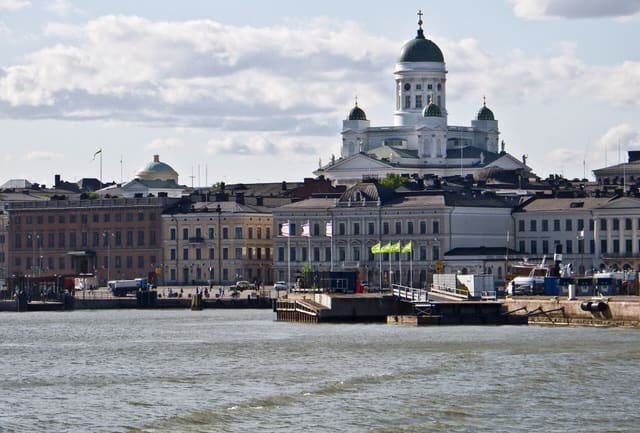
Why Helsinki
Before the detail, the snapshot - what you actually get by studying in the capital.
- University of Helsinki: Finland’s top university (broadly top-100 globally) and strongest in research breadth
- Hanken School of Economics: a triple-accredited (AACSB, EQUIS, AMBA) business school for finance and economics master’s
- The economic centre of Finland: corporate HQs, the gaming cluster (Supercell, Rovio), biotech, finance and a lively start-up scene
- The largest and most established international student community in the country, on the Baltic coast
Universities & popular master’s
Look past the overall ranking to the subject strength and the language of instruction - almost every programme here is taught in English.
- University of Helsinki: respected English-taught master’s in Data Science, Computer Science, Life Sciences, Economics, Atmospheric Sciences and International Business Law
- Hanken School of Economics: master’s in Finance and Economics with strong corporate links
- Curriculum flexibility: most Finnish master’s run two years (120 ECTS), with thesis projects done for real companies and exchange semesters abroad
- Global recognition: Finnish degrees sit in the EU Bologna system, so your master’s is recognised across Europe and widely beyond
Career prospects & ROI
Finland actively wants to keep international graduates - the post-study rules are some of the most generous in Europe.
- Post-study work: after graduating you can get a two-year residence permit to look for a job or start a business - one of the longest job-search windows in the EU
- Industry connections: master’s theses and internships are commonly done with employers, the main bridge into a first job in tech, gaming, finance and biotech
- Employment: Finland faces a skilled-labour shortage and an ageing workforce, so demand for graduates in IT, engineering and health is high
- A Helsinki master’s plus some Finnish travels well across the Nordics and the wider EU
Cost of living in Helsinki
Estimates for the 2026 academic yearA student in Helsinki should budget around 895 € a month. The heaviest line by far is rent: a room in a shared flat goes for about 420 €, and most land between 330 € and 600 €.
- Room in a shared flat usually 330 € – 600 €
- 420 €
- Food and groceries
- 250 €
- Student travel pass
- 35 €
- Health insurance
- 45 €
- Phone, internet, electricity
- 45 €
- Books, sport, going out
- 100 €
- Monthly total
- 895 €
Ranked 8 of 8 on cost among the cities we cover in Finland, cheapest first.
Cheapest on our list: Lappeenranta (LUT), at about 755 € a month. →What things cost here, against the EU
Across the whole shopping basket Finland sits at 127.2, where the EU average is 100 (2024).
EU average = 100
Consumer prices rose 1.8% over 2025.
Where these numbers come from
The monthly budget is our own estimate, compiled from what student unions, universities and national student services publish. Use it to plan with — it is not a quote.
The price levels, inflation and rent figures are published statistics: Eurostat purchasing power parities and, for German states, the Federal Statistical Office (Destatis).
Success stories
Students who crossed the bridge

“I wasted a year trying alone. After the strategy call I knew exactly which documents I was missing - three months later I had my admission.”Read full story →

“They prepared my visa file so well the interview took ten minutes. They even helped my parents understand the blocked account.”Read full story →

“With the VIP pack I arrived in Finland with my room, bank account and even my airport pickup organised. I just had to study.”Read full story →
What it costs
Tuition for non-EU students is real, but scholarships routinely cut it sharply - and the city, not the fee, is the bigger budget line.
- Tuition: roughly €13,000–€18,000/year for a non-EU/EEA master’s; EU/EEA citizens pay no tuition
- Scholarships: the universities award tuition waivers of 50–100% for strong applicants, sometimes with a living-cost top-up - apply at the same time as your programme
- Living costs: budget about €900–€1,400/month in Helsinki, driven mainly by rent - HOAS student housing is by far the cheapest option
- Proof of funds & work: show about €800/month (≈€9,600/year) for the residence permit; students may work up to ~30 hours a week alongside studies
Life, safety & culture
A safe, compact Nordic capital where English gets you a long way - and the world’s happiest country around it.
- Daily language is Finnish (with Swedish official too), but English is spoken almost everywhere and used across study, tech and start-ups
- Safety: Finland ranks as the world’s happiest country and among the safest - very low crime, with student healthcare (FSHS) for a small annual fee
- Getting around: an easy metro, tram and train network, plus ferries and flights across the Baltic and the Nordics
- Student environment: a true capital-city experience with a large, diverse international community and active student associations
How to apply & the bureaucracy
Most master’s run through the national Studyinfo portal - start early, because the steps are sequential.
- Apply via Studyinfo.fi; the main joint application for autumn intake opens in early January and closes in late January
- Admission requirements: a relevant bachelor’s degree, transcripts, a motivation letter and often two references; some programmes ask for the GRE
- Language proficiency: typically IELTS 6.5 (no band under 5.5) or TOEFL iBT ~92 - confirm the exact score on the programme page
- After admission, apply for the student residence permit through Migri immediately; allow several weeks to a few months, and the permit covers your whole study period
Read these guides next
Want UniBridgeEurope to do all of this for you?
We take African students from first choice to arrival in Europe: university shortlist, applications, student visa, flights, bank account and housing. Start with a €99 strategy call, or choose the package that comes with an admission guarantee.