
For universities & colleges

University website development built to recruit, enrol and retain

Fast, accessible, search-optimised websites and student portals for higher education — engineered to convert prospective students and integrate cleanly with the systems your campus already runs.

Email our team
Higher-education web team designing an accessible, responsive university website on a laptop

Built for the student journey

From the first programme search to a submitted application, every page is engineered to move prospective students towards enrolment.

Accessible & compliant by default

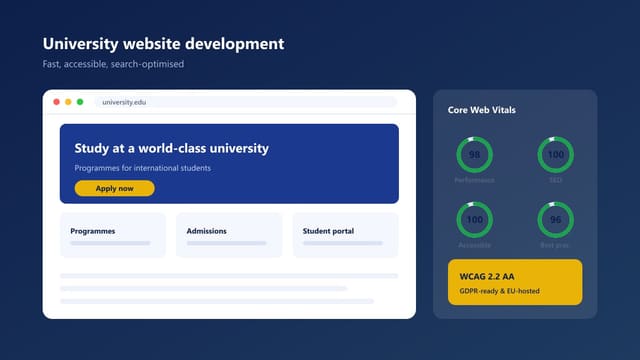
WCAG 2.2 AA, GDPR-ready consent and data minimisation are built in from day one — not bolted on the week before an audit.

Integrates with your stack

A resilient API layer connects your site to CRM, SIS and LMS without ever exposing fragile, decades-old legacy systems.

What we build for higher education

Decoupled, composable architecture

Statically generated or server-rendered marketing sites for SEO and speed, with frameworks like Angular powering interactive applicant and student portals.

CRM, SIS & LMS integration

A middleware API layer pipes leads, documents and application status into Slate or Salesforce, reads course data from Banner or Workday, and hands authentication off to Canvas or Moodle.

SSO & identity management

Federated single sign-on with SAML, Shibboleth or Active Directory, so users move between site, application portal, library and LMS without logging in twice.

Conversion-focused admissions UX

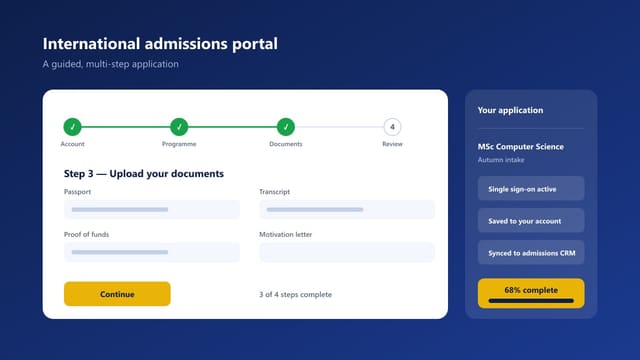
Multi-step international admission workflows, dynamic course registration and clear calls to action that turn interest into completed applications.

Technical SEO & performance

Core Web Vitals, semantic markup, structured data and multilingual hreflang built in, so your programmes rank for the searches that matter in every market.

Accessibility & governance

WCAG 2.2 AA testing, a locked-down design system and role-based access control that keep every department on-brand and legally compliant.

Diagram of a decoupled university web platform connecting the public site and student portal to CRM, SIS and LMS through an API layer

How a web development project works

1

Discovery & audit

We map your audiences, audit your current site for accessibility, speed and SEO gaps, and document every system we need to integrate with.

2

Architecture & design

We design the information architecture and a reusable, accessible component system, and define the API layer that connects to your CRM, SIS and LMS.

3

Build & integrate

We develop the marketing site and portals, wire up SSO and the data integrations, and test against WCAG and Core Web Vitals targets.

4

Launch & iterate

We migrate content, launch with full analytics and conversion tracking, then optimise against your enrolment goals each term.

What we build

A university website is rarely a single site — it is a decentralised digital ecosystem that has to serve conflicting audiences at once and convert international applicants while it does it. We design and build every layer of it.

  • Public marketing sites for prospective-student recruitment
  • International admission and online application portals
  • Student and applicant self-service dashboards
  • Programme and course-catalogue experiences
  • Department and faculty microsites on one shared design system
  • Multilingual sites for Africa, the Middle East and Europe
  • Accessibility and WCAG 2.2 AA remediation projects
  • Legacy website migrations and re-platforming

Why universities choose us to build their website

  • A team that understands the international student journey, not just generic corporate web design.
  • Architecture that survives thousands of pages and decentralised departmental authoring.
  • Accessibility and GDPR compliance treated as requirements, not afterthoughts.
  • Clean integration with the CRM, SIS and LMS you already run — no risky direct database access.
  • Measurable results: faster load times, higher application-completion rates and better search rankings.
  • One partner for the public site, the applicant portal and the recruitment campaigns that feed them.
International applicant completing a multi-step university admissions portal on a laptop and phone

Professional web development for universities and higher education

Building a web platform for a higher-education institution is fundamentally different from a standard corporate build. It is rarely a single website — it is a massive, decentralised digital ecosystem that has to serve conflicting user needs, integrate with archaic legacy systems and adhere to strict public-sector compliance. A research university, a university of applied sciences and a pathway provider all face the same core challenge: thousands of pages, dozens of departments authoring them, and a homepage that must recruit prospective students and serve current ones in the same breath.

At institutional scale, monolithic setups collapse under the weight of those pages and competing departmental needs, so the industry standard is a decoupled or composable architecture. We separate the public marketing site — statically generated or server-side rendered to maximise SEO and load speed — from the authenticated portals, where heavy, real-time interactivity is essential. Robust frontend frameworks like Angular are ideal for managing complex states such as multi-step international admission workflows or dynamic course registration. Crucially, we never connect a frontend directly to decades-old backend systems; instead we build a resilient API layer, often on serverless infrastructure, to aggregate data, handle caching and serve it cleanly.

A university web platform acts as a central router that pipes data into specialised enterprise systems. Recruitment and admissions CRMs such as Slate or Salesforce for Higher Ed manage the applicant pipeline, so the platform must securely pipe lead data, document uploads and application statuses into them — critical for tracking complex international recruitment channels and agency submissions. The Student Information System (Ellucian Banner, Workday) remains the definitive record for catalogues and balances, and the platform pulls from it to display course data. The Learning Management System (Canvas, Moodle) hosts the academic content, so the web layer primarily handles a clean authentication handoff. Federated single sign-on via SAML, Shibboleth or Active Directory ties it all together, moving users between site, portal, library and learning environment without repeated logins.

The homepage itself is a battleground for digital real estate, because it serves vastly different funnels simultaneously. Prospective students need a highly visual, marketing-driven experience designed to drive applications, campus tours and information requests. Current students and faculty do not care about marketing copy — they want immediate access to the portal, the directory, library databases and daily utilities. Professional university sites solve this with strict user segmentation, often a streamlined "current students" utility bar above a recruitment-focused main canvas, and an experience that shifts entirely from marketing to utility the moment a user authenticates.

Because universities are frequently public or publicly funded, the legal and structural requirements are non-negotiable, and we build to them by default. Adherence to WCAG 2.1 / 2.2 Level AA is legally required in most jurisdictions, which means rigorous automated and manual testing for screen-reader compatibility, keyboard navigation and colour contrast. With a global applicant pool, GDPR compliance demands explicit consent flows, strict data minimisation and EU-region hosting for international applicant data. And because authoring is decentralised, a locked-down design system with predefined components and role-based access control is essential to stop rogue departments breaking brand guidelines or introducing accessibility violations. The result is a platform that ranks, converts and stays compliant as it grows.

Frequently asked questions

Do you build both the public website and the student portals?

Yes. We build the public, SEO-driven marketing site and the authenticated applicant and student portals, on one shared, accessible design system and a single sign-on layer so users move between them seamlessly.

Can you integrate with our existing CRM, SIS and LMS?

Yes. We build a resilient middleware API layer that connects to admissions CRMs like Slate or Salesforce, reads from a Student Information System such as Banner or Workday, and hands authentication off to an LMS like Canvas or Moodle — without exposing your legacy systems directly.

Will the website be WCAG accessible and GDPR compliant?

Yes. We build to WCAG 2.2 Level AA with automated and manual screen-reader, keyboard and contrast testing, and to GDPR with explicit consent flows, data minimisation and EU-region hosting for international applicant data.

Which technologies do you use?

A decoupled, composable architecture: statically generated or server-rendered marketing sites for speed and SEO, Angular for interactive applicant and student portals, and a Node or serverless API gateway in front of your existing backends.

Can you migrate our current site without losing SEO?

Yes. We map every URL, put redirects in place, preserve and improve structured data and metadata, and benchmark Core Web Vitals before and after, so rankings are protected — and usually improved — through the migration.

How long does a university website project take?

A focused marketing-site or portal build typically runs from discovery to launch in a few months; a full ecosystem with multiple integrations is phased. We scope timelines together on a strategy call once we understand your systems and goals.

Build a university website that recruits

Tell us about your institution, your current site and the systems you run. We’ll come back with an architecture and a plan built around your enrolment goals — no obligation.

Email our team

Typical reply within one business day. Accessible, compliant builds for higher education.

Book a strategy call

Leave your name and phone number and our team will call you back to plan your international intake — usually within one business day.

Include your country code, e.g. +234 for Nigeria.
Confirm you are human

We use your details only to contact you about this enquiry. No spam.