Netherlands · South Holland
Study in Rotterdam in English: Erasmus University, business careers and costs
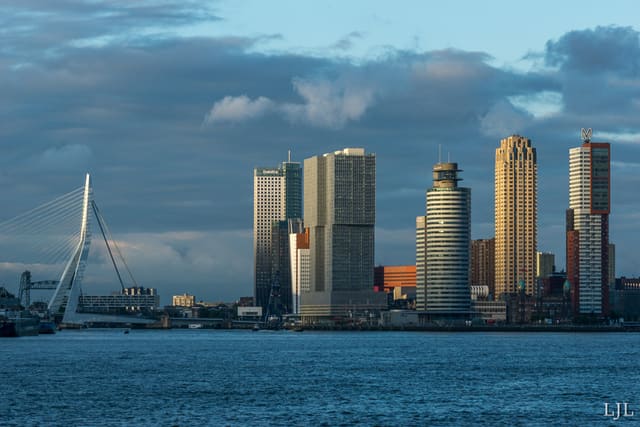
Rotterdam is the Netherlands’ second city and home to Erasmus University Rotterdam (EUR), one of Europe’s leading universities for business, economics and management through Rotterdam School of Management (RSM) and the Erasmus School of Economics. The city is built around the largest port in Europe, which makes it a natural base for logistics, supply chain, trade and energy. It is strikingly modern, noticeably more affordable than Amsterdam, and unusually international for its size.
Why Rotterdam
A specialist business-and-trade city where your degree sits next to the industry that hires for it.
- Erasmus University Rotterdam: a global top-100 university and one of Europe’s best for business, economics and management
- Rotterdam School of Management (RSM) and the Erasmus School of Economics are internationally ranked; Erasmus MC is a leading medical and health-sciences centre
- The Port of Rotterdam, the largest in Europe, anchors a huge logistics, supply-chain, trade and energy sector
- A bold, modern, multicultural city - more affordable than Amsterdam and very used to international students
Universities & English-taught programmes
Strong, specific subject strength - exactly the “top for one field” situation worth choosing for.
- A wide range of English-taught bachelor’s and master’s in international business, economics, finance, management, supply chain and analytics
- RSM is one of Europe’s largest business schools; the Erasmus School of Economics is a top address for economics and econometrics
- Most programmes are English-taught from bachelor’s level up, so you do not need Dutch to study
- Curriculum flexibility: exchange semesters with partner schools worldwide, double degrees and applied, case-based teaching with company projects
Career prospects & ROI
A direct line into business, finance, consulting and the logistics sector around the port.
- Industry connections: multinationals, banks, consultancies and the port-linked logistics, trade and energy companies recruit EUR graduates directly
- Internships and case competitions are woven into the programmes and are the main route into a first role
- Post-study work: the one-year orientation year (zoekjaar) lets you stay to find work or start a business after graduating
- A globally recognised business or economics degree from Rotterdam travels exceptionally well with international employers
Cost of living in Rotterdam
Estimates for the 2026 academic yearA student in Rotterdam should budget around 1.155 € a month. The heaviest line by far is rent: a room in a shared flat goes for about 550 €, and most land between 430 € and 700 €.
- Room in a shared flat usually 430 € – 700 €
- 550 €
- Food and groceries
- 280 €
- Student travel pass
- 55 €
- Health insurance
- 60 €
- Phone, internet, electricity
- 80 €
- Books, sport, going out
- 130 €
- Monthly total
- 1.155 €
Ranked 3 of 4 on cost among the cities we cover in Netherlands, cheapest first.
Cheapest on our list: Maastricht, at about 1.105 € a month. →What things cost here, against the EU
Across the whole shopping basket Netherlands sits at 121.0, where the EU average is 100 (2024).
EU average = 100
Consumer prices rose 3.0% over 2025.
Where these numbers come from
The monthly budget is our own estimate, compiled from what student unions, universities and national student services publish. Use it to plan with — it is not a quote.
The price levels, inflation and rent figures are published statistics: Eurostat purchasing power parities and, for German states, the Federal Statistical Office (Destatis).
Success stories
Students who crossed the bridge

“I wasted a year trying alone. After the strategy call I knew exactly which documents I was missing - three months later I had my admission.”Read full story →

“They prepared my visa file so well the interview took ten minutes. They even helped my parents understand the blocked account.”Read full story →

“With the VIP pack I arrived in Finland with my room, bank account and even my airport pickup organised. I just had to study.”Read full story →
What it costs
A top-ranked business education at lower living costs than the capital.
- Tuition for non-EU/EEA students: roughly €9,000–€14,000 a year for a bachelor’s and €11,000–€20,000 for a master’s
- Living costs: about €1,000–€1,350/month - meaningfully cheaper than Amsterdam, with student housing and shared flats the cheapest option
- Proof of funds for the visa: roughly €14,000 for the year (about €1,150/month); the university acts as your recognised sponsor for the entry visa (MVV) and residence permit
- Part-time work: up to 16 hours a week in term (or full-time in June–August) with an employer work permit (TWV); budget about €50–€140/month for health insurance
Life, safety & culture
Modern, walkable and international, with the whole Randstad within easy reach.
- Daily language is Dutch, but English is spoken almost everywhere and all your study and most jobs can be in English - some Dutch helps socially
- Excellent metro, trams and trains, with fast connections to Amsterdam, The Hague and Schiphol airport, and cycling everywhere
- A safe city with strong healthcare; students take out Dutch or international health insurance to cover it
- A young, diverse, design-forward city with a large international student community and active diaspora groups
How to apply & the bureaucracy
Erasmus University applies through Studielink and its own portal - start early.
- Apply via Studielink and the EUR admissions system; non-EU deadlines are typically around 1 April for a bachelor’s and earlier for many master’s - check each programme
- English-taught programmes accept IELTS or TOEFL; bachelor’s usually need IELTS 6.0–6.5 and master’s 6.5 (some business master’s also ask for a GMAT/GRE)
- Selective (numerus fixus) and selection programmes have fixed early deadlines (often 15 January) - confirm whether yours is one
- Once admitted, the university files your entry visa (MVV) and residence permit as a recognised sponsor; allow several weeks and prepare proof of funds early
Read these guides next
Want UniBridgeEurope to do all of this for you?
We take African students from first choice to arrival in Europe: university shortlist, applications, student visa, flights, bank account and housing. Start with a €99 strategy call, or choose the package that comes with an admission guarantee.