Hungary · Southern Transdanubia
Study in Pécs: universities, costs and careers for international students
Pécs has the longest academic history in Hungary - the university was founded in 1367 - and the country’s most experienced international medical faculty. The Medical School has taught General Medicine in English since the mid-1980s, the first programme of its kind in Hungary, and the university now hosts more than 5,000 international students from over 130 countries. The city is the warmest in the country, sheltered under the Mecsek hills near the Croatian border, with a UNESCO-listed Early Christian necropolis beneath its centre and a European Capital of Culture title from 2010. It is small, cheap and a long way from Budapest - which is the whole argument, both for and against. Here is what to weigh.
Why Pécs
Before the detail, the snapshot - what you actually get by studying in southern Transdanubia.
- The University of Pécs traces its foundation to 1367, making it the oldest university in Hungary - and it is a broad, ten-faculty university rather than a specialist one
- The Medical School has taught in English since the mid-1980s, the first English-language medical programme in the country, and also runs a German-language track
- More than 5,000 international students from over 130 countries - proportionally the most international student body in Hungary
- A warm, Mediterranean-tinged climate under the Mecsek hills, and a compact centre you can cross on foot in twenty minutes
- European Capital of Culture in 2010, which paid for the Zsolnay Quarter, the Kodály Centre concert hall and the Knowledge Centre library
- Living costs are among the lowest in Hungary, and dormitory places are open to international students
Universities & popular courses
One university, ten faculties, and an English-taught offer that reaches well beyond medicine.
- General Medicine in English: a six-year programme and the most established international medical degree in Hungary, taught at the Medical School with its own clinical centre
- Dentistry, Pharmacy and Biotechnology in English: five-year and master’s programmes alongside medicine, all with international cohorts
- Engineering and information technology: English-taught programmes in civil engineering, architecture, computer science engineering and electrical engineering
- Business and economics: business administration, applied management and international business in English, with an MBA
- Also in English: psychology, international relations, earth sciences and a range of teacher-training and arts programmes
- Curriculum: bachelor’s degrees run three to four years, master’s two, medicine six and dentistry and pharmacy five, with clinical rotations in the final medical year
- A one-year preparatory course in English prepares applicants whose school-leaving qualification falls short of the medical entry requirement - a common route in for students from West Africa
Career prospects & ROI
The degree travels a long way further than the local job market does - plan for that from the start.
- The medical degree is the strongest career asset Pécs offers: recognised across the EU, with graduates going into residency in Hungary, Germany, Scandinavia, the UK and their home countries. Confirm your own country’s recognition process before you enrol
- Industry connections locally are thinner than in Budapest or Debrecen - the largest employers are the university and its clinical centre, the regional health service and a handful of engineering and IT firms
- Engineering and IT graduates typically look to Budapest, or across the border to Austria and Germany, where a Hungarian degree needs no further recognition step
- Work while you study: up to 30 hours a week in term time and full-time for up to 90 days outside it, on a student residence permit with no separate work permit. Confirm the current limits with the immigration authority
- After you graduate: the nine-month, non-extendable job-search and entrepreneurship residence permit, filed at least 15 days before your student permit expires
- The honest trade-off: Pécs is the cheapest and most welcoming of the four cities and has the weakest local job market. Choose it for the degree and the cost, and plan to move for the first job unless you are in medicine
Cost of living in Pécs
Estimates for the 2026 academic yearA student in Pécs should budget around 610 € a month. The heaviest line by far is rent: a room in a shared flat goes for about 220 €, and most land between 170 € and 300 €.
- Room in a shared flat usually 170 € – 300 €
- 220 €
- Food and groceries
- 200 €
- Student travel pass
- 10 €
- Health insurance
- 30 €
- Phone, internet, electricity
- 70 €
- Books, sport, going out
- 80 €
- Monthly total
- 610 €
Ranked 1 of 4 on cost among the cities we cover in Hungary, cheapest first.
What things cost here, against the EU
Across the whole shopping basket Hungary sits at 68.3, where the EU average is 100 (2024).
EU average = 100
Consumer prices rose 4.4% over 2025.
Where these numbers come from
The monthly budget is our own estimate, compiled from what student unions, universities and national student services publish. Use it to plan with — it is not a quote.
The price levels, inflation and rent figures are published statistics: Eurostat purchasing power parities and, for German states, the Federal Statistical Office (Destatis).
Success stories
Students who crossed the bridge

“I wasted a year trying alone. After the strategy call I knew exactly which documents I was missing - three months later I had my admission.”Read full story →

“They prepared my visa file so well the interview took ten minutes. They even helped my parents understand the blocked account.”Read full story →

“With the VIP pack I arrived in Finland with my room, bank account and even my airport pickup organised. I just had to study.”Read full story →
What it costs
Among the lowest living costs in the EU, with medicine again the exception on tuition.
- Self-financed tuition: roughly EUR 3,000-6,000 a year for engineering, IT, business and the social sciences. General Medicine is around USD 16,750 a year for the 2026/27 intake, charged in two unequal semester instalments, with dentistry higher
- Stipendium Hungaricum covers tuition in full and adds the HUF 43,700 monthly stipend, a dormitory place or HUF 40,000 a month towards rent, and medical insurance
- Living costs: budget EUR 400-600 a month. A room in a shared flat runs EUR 180-320 and a dormitory place much less
- The city is small enough that many students never buy a transport pass; the bus network is cheap and there is a student rate
- One-off costs: visa and residence-permit fees, health insurance for the whole stay, a rental deposit and the entrance-examination fee for medicine
- The visa asks for proof of means for the year, shown as a bank statement or the scholarship award letter
Life, safety & culture
A warm, layered, small city that international students consistently describe as the easiest place in Hungary to settle into.
- Language: the medical and engineering faculties run entirely in English, but the city does not - Hungarian matters for renting, shopping and part-time work, and the university runs courses
- One of the safest cities in Hungary and small enough that students walk everywhere: the medical campus, the centre and most student housing sit within a few minutes of each other
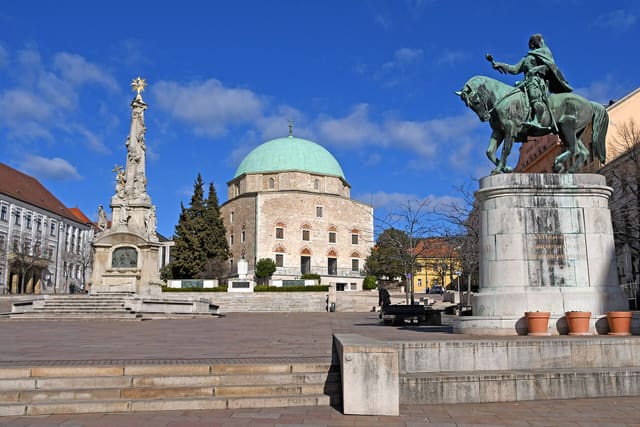
- Széchenyi tér, the main square, is dominated by the Mosque of Pasha Qasim - an Ottoman mosque turned Catholic church, and the clearest reminder that this was a frontier city for a century and a half
- A UNESCO World Heritage site sits beneath the cathedral: the fourth-century Early Christian necropolis of Sopianae
- Healthcare: the university clinical centre is the regional teaching hospital and treats its own students, and insurance for the whole stay is a condition of the residence permit
- The trade-off: Pécs is around three hours from Budapest by train and has no international airport of its own, the city is quiet outside term time, and the nightlife is student-scaled rather than capital-scaled
How to apply & the bureaucracy
The standard Hungarian process, run by an international office with forty years of practice at it.
- Stipendium Hungaricum: through the Tempus Public Foundation portal and your home country’s sending partner in the same round, opening in November and closing in mid-January
- Self-financed: apply directly to the University of Pécs, generally from January for a September start, with rolling assessment through the spring - medical places fill early
- Medicine, dentistry and pharmacy require an entrance examination in biology and chemistry with an oral component. Pécs runs it at centres in a long list of countries as well as in the city, and offers the preparatory year to applicants who fall short
- Language proficiency: typically IELTS 5.5-6.5 or TOEFL iBT 72-90 depending on the faculty; the Medical School may accept an interview instead where your entire secondary schooling was in English
- Documents: school-leaving certificate or degree, transcripts, passport, medical certificate, motivation letter and references - legalised with an apostille or consular legalisation and translated
- After acceptance, apply for the type D visa through the Enter Hungary portal at the Hungarian consulate and convert it into a study residence permit within the deadline after you arrive
Read these guides next
Want UniBridgeEurope to do all of this for you?
We take African students from first choice to arrival in Europe: university shortlist, applications, student visa, flights, bank account and housing. Start with a €99 strategy call, or choose the package that comes with an admission guarantee.