France · Grand Est
Study in Strasbourg: the European capital on the German border
Strasbourg is unlike anywhere else in France: it hosts the European Parliament and the Council of Europe, sits directly on the German border, and offers a bilingual French-German environment that opens two job markets at once. For students drawn to law, political science, European affairs or the sciences, it is a distinctive and affordable choice.
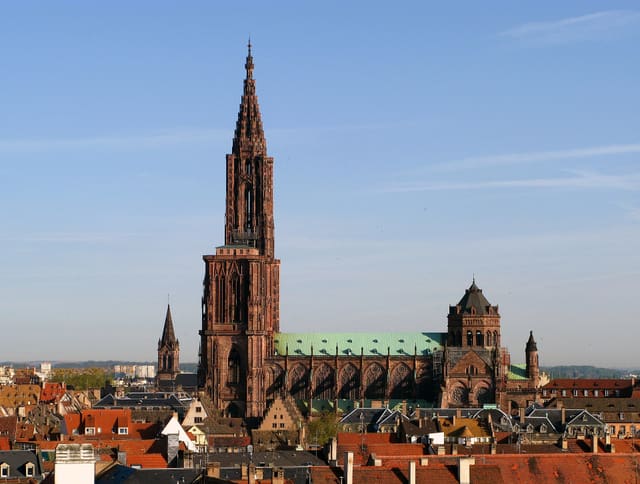
Why Strasbourg
A European institutional capital with a research university and a cross-border advantage.
- Seat of the European Parliament and the Council of Europe - a hub for EU law, politics and diplomacy
- Université de Strasbourg (Unistra): a large research university with several Nobel laureates, strong in chemistry, law, sciences and medicine
- Directly on the German border, with deep French-German ties and the chance to study or work across it
- A beautiful, safe, very international mid-size city
Universities & popular bachelor’s
Distinctive strengths in European studies, law and the sciences - plus a bilingual edge.
- Université de Strasbourg: strong bachelor’s (licence) in law, political science, chemistry, life sciences and languages
- Sciences Po Strasbourg: a respected route into political science, European affairs and public administration
- European studies and cross-border programmes leverage the city’s EU institutions and German neighbour
- Bilingual French-German tracks are a real curriculum option - and a career asset
Career prospects & ROI
Two job markets and a direct line to the EU institutions.
- Industry connections: EU institutions, international law and diplomacy, plus cross-border employers in Germany
- French-German bilingualism opens the German job market - one of Europe’s strongest - alongside France
- Post-study: master’s-level graduates qualify for the 12-month job-search permit (APS); European-affairs and legal profiles travel well
- Strong return in fields tied to EU policy, law, chemistry and the life sciences
Cost of living in Strasbourg
Estimates for the 2026 academic yearA student in Strasbourg should budget around 932 € a month. The heaviest line by far is rent: a room in a shared flat goes for about 450 €, and most land between 370 € and 560 €.
- Room in a shared flat usually 370 € – 560 €
- 450 €
- Food and groceries
- 250 €
- Student travel pass
- 32 €
- Health insurance
- 25 €
- Phone, internet, electricity
- 65 €
- Books, sport, going out
- 110 €
- Monthly total
- 932 €
Ranked 5 of 8 on cost among the cities we cover in France, cheapest first.
Cheapest on our list: Grenoble, at about 902 € a month. →What things cost here, against the EU
Across the whole shopping basket France sits at 107.9, where the EU average is 100 (2024).
EU average = 100
Consumer prices rose 0.9% over 2025.
Where these numbers come from
The monthly budget is our own estimate, compiled from what student unions, universities and national student services publish. Use it to plan with — it is not a quote.
The price levels, inflation and rent figures are published statistics: Eurostat purchasing power parities and, for German states, the Federal Statistical Office (Destatis).
Success stories
Students who crossed the bridge

“I wasted a year trying alone. After the strategy call I knew exactly which documents I was missing - three months later I had my admission.”Read full story →

“They prepared my visa file so well the interview took ten minutes. They even helped my parents understand the blocked account.”Read full story →

“With the VIP pack I arrived in Finland with my room, bank account and even my airport pickup organised. I just had to study.”Read full story →
What it costs
An affordable mid-size city with full big-university resources.
- Public tuition: roughly €2,900/year for a non-EU bachelor at the public university
- Living costs: about €750–€1,000/month, with CROUS student housing the cheapest option
- Proof of funds: about €615/month for the visa - bank statement or sponsor declaration, no blocked account
- Part-time work: up to 964 hours a year; CAF housing aid available, and cross-border student jobs are possible
Life, safety & culture
Compact, international and genuinely cross-cultural.
- Daily language is French; German is widely spoken and useful, and bilingual programmes exist - aim for B1–B2 French
- A safe, walkable, canal-lined city with a strong quality of life
- A very international student body thanks to the EU institutions and German proximity
- Easy travel across France, Germany and the wider EU by train
How to apply & the bureaucracy
Public university via Campus France; Sciences Po Strasbourg has its own route.
- Apply to Université de Strasbourg through “Études en France” / Campus France
- First-year bachelor applicants typically use the DAP procedure with a French language test
- French-taught programmes need DELF/DALF B2; check bilingual tracks for German requirements too
- After admission, book the student-visa appointment immediately (4–12 weeks)
Read these guides next
Want UniBridgeEurope to do all of this for you?
We take African students from first choice to arrival in Europe: university shortlist, applications, student visa, flights, bank account and housing. Start with a €99 strategy call, or choose the package that comes with an admission guarantee.