Scotland · Glasgow City
Study in Glasgow: universities, costs and careers for international students
Glasgow is Scotland’s largest city and its industrial and engineering heart. The University of Glasgow has been running since 1451, Strathclyde is one of the UK’s strongest engineering and business schools, and the city builds more small satellites than anywhere else in Europe. It is also markedly cheaper than Edinburgh, and Glaswegians have a well-earned reputation as the friendliest people in Britain. As in the rest of Scotland, the bachelor’s degree runs four years. Here is what to weigh.
Why Glasgow
Before the detail, the snapshot - what you actually get by studying here.
- The University of Glasgow: founded in 1451, in the global top 100, with the Adam Smith Business School and a medical school with a 500-year history
- The University of Strathclyde: an engineering and business powerhouse, twice named UK University of the Year, with very strong industry partnerships
- Glasgow Caledonian University, the Glasgow School of Art and the Royal Conservatoire of Scotland alongside them - four very different routes in one city
- The cheapest large student city in Scotland, and among the cheapest in the UK for its size
Universities & popular courses
Look past the overall ranking to the subject table and the degree length - Scotland works differently.
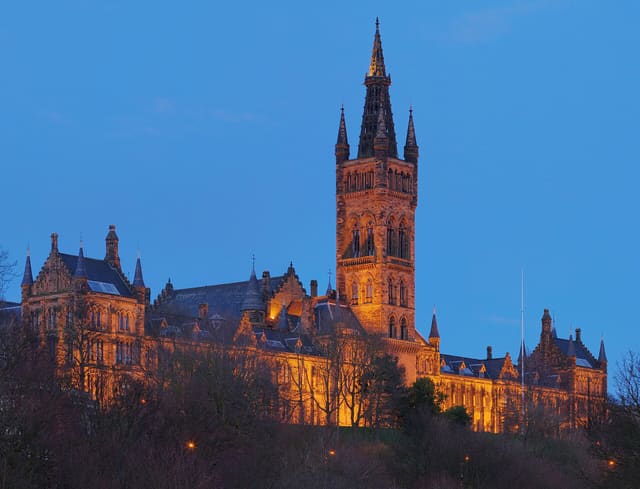
- University of Glasgow: medicine, dentistry, veterinary medicine, law, engineering, computing science and business - and one of the most photographed campuses in Britain
- University of Strathclyde: chemical, mechanical, electrical, civil and naval engineering, plus the Strathclyde Business School, which runs an internationally accredited MBA
- Glasgow Caledonian: nursing, allied health, risk management, construction and business, with entry requirements aimed squarely at applicants who need a practical route in
- Degree length: a Scottish bachelor’s is four years, with advanced entry into year two available to strong applicants; master’s degrees remain twelve months
- Curriculum flexibility: the broad first two years let you change specialism without restarting - unusual in the UK and genuinely useful
Career prospects & ROI
A genuine engineering job market, plus finance operations that hire in volume.
- Industry connections: BAE Systems builds Royal Navy ships on the Clyde, Rolls-Royce, Weir Group, SSE and ScottishPower recruit engineers directly, and Glasgow manufactures more small satellites than any other European city
- Financial services: Barclays runs a large campus in Tradeston, JPMorgan a technology centre, and Morgan Stanley and abrdn have Glasgow operations - most of these hire technology and operations graduates, not just finance graduates
- NHS Greater Glasgow and Clyde is the largest health board in the UK and the main employer for nursing, midwifery and allied-health graduates
- Post-study work: the Graduate visa applies in Scotland on the same terms as the rest of the UK
- Graduate salaries typically start £24,000-£30,000 against some of the lowest rents of any major UK city
Cost of living in Glasgow
Estimates for the 2026 academic yearA student in Glasgow should budget around 1.275 € a month. The heaviest line by far is rent: a room in a shared flat goes for about 610 €, and most land between 480 € and 770 €.
- Room in a shared flat usually 480 € – 770 €
- 610 €
- Food and groceries
- 280 €
- Student travel pass
- 70 €
- Health insurance
- 75 €
- Phone, internet, electricity
- 90 €
- Books, sport, going out
- 150 €
- Monthly total
- 1.275 €
Ranked 3 of 8 on cost among the cities we cover in United Kingdom, cheapest first.
Cheapest on our list: Coventry, at about 1.225 € a month. →What things cost here, against the EU
Across the whole shopping basket United Kingdom sits at 129.1, where the EU average is 100 (2024).
EU average = 100
Where these numbers come from
The monthly budget is our own estimate, compiled from what student unions, universities and national student services publish. Use it to plan with — it is not a quote.
The price levels, inflation and rent figures are published statistics: Eurostat purchasing power parities and, for German states, the Federal Statistical Office (Destatis).
Success stories
Students who crossed the bridge

“I wasted a year trying alone. After the strategy call I knew exactly which documents I was missing - three months later I had my admission.”Read full story →

“They prepared my visa file so well the interview took ten minutes. They even helped my parents understand the blocked account.”Read full story →

“With the VIP pack I arrived in Finland with my room, bank account and even my airport pickup organised. I just had to study.”Read full story →
What it costs
The best value of any big UK university city - as long as you budget for four years, not three.
- Tuition for international students: roughly £22,000-£30,000 a year at the University of Glasgow, £18,000-£25,000 at Strathclyde and £15,000-£18,000 at Glasgow Caledonian - medicine and dentistry are far higher
- Living costs: budget £850-£1,100 a month. A room in a shared flat in the West End, Dennistoun or Govanhill runs £450-£700; university halls £550-£850
- Proof of funds for the visa: the non-London maintenance rate applies - check the current monthly figure and hold it for 28 consecutive days
- Transport: the Glasgow Subway plus buses and trains; a student season ticket runs about £300-£400, and West End students walk to campus
- Scholarships: Chevening and Commonwealth awards, the University of Glasgow’s International Leadership Scholarships, Strathclyde’s Dean’s Excellence Awards and GCU’s international scholarships
Life, safety & culture
Warm, loud and unpretentious - with an established African community.
- Everything is in English; the Glaswegian accent is the steepest in the UK for the first month, and then it is not
- Glasgow has a long-established Nigerian, Ghanaian and Zimbabwean community, active African student societies and Pentecostal churches across the south side
- Safety: Glasgow has improved dramatically over two decades and the student areas are ordinary and safe, but it is a large city and the usual precautions apply at night
- Healthcare: NHS Scotland through the Immigration Health Surcharge, with free prescriptions
- The West End around the university is full of cheap food, live music and second-hand shops - the social life here costs a fraction of London’s
How to apply & the bureaucracy
The UK sequence, with the same Scottish quirk on degree length.
- Bachelor’s: apply through UCAS by the late-January deadline; medicine, dentistry and veterinary medicine close in mid-October
- Ask about advanced entry to year two - it saves a full year of tuition and living costs and is common for applicants with A-levels or the IB
- Master’s: apply directly from September; Strathclyde and Glasgow both run rolling admissions on their taught master’s
- English proficiency: IELTS 6.5 with 6.0 in each component at Glasgow and Strathclyde; GCU often accepts 6.0 overall
- After the CAS, apply for the Student visa with proof of funds, the health surcharge and a TB certificate where required; allow three to eight weeks
Read these guides next
Free for UK applicants
Apply to UK universities for free
UK universities pay us when a student enrols, so our help with your UK application costs you nothing. We shortlist programmes with you, check your documents and guide you through offer, deposit, CAS and visa.
- Applications to up to 5 UK universities
- Help with your deposit, CAS and Student visa
- One advisor from the first call to enrolment
Our service is free for you: UK universities pay UniBridgeEurope a fee when a student enrols. You still pay your own tuition, visa and healthcare fees.