Germany · Hesse
Study in Frankfurt am Main in English: universities, costs and finance careers
Frankfurt is Germany’s financial capital and its most international city: the European Central Bank, the Deutsche Börse and most of the country’s banking sector are here, and the airport connects to more African cities than any other in Europe. Goethe University is one of Germany’s largest, with a strong economics and finance faculty, and the city adds a public university of applied sciences and a private business school teaching entirely in English. If your plan is finance, economics, consulting or logistics, few places in Europe put you closer to the employers.
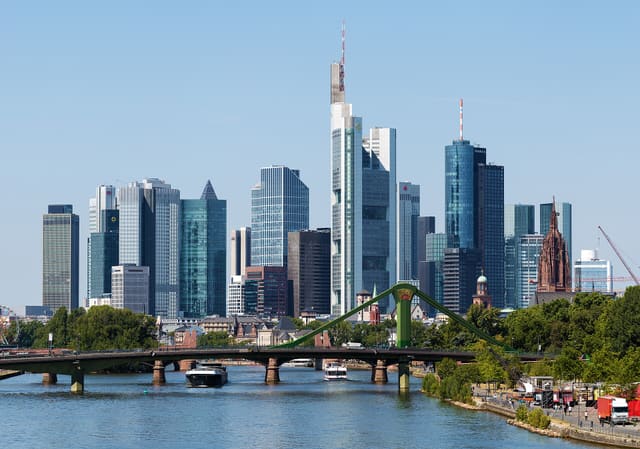
Why Frankfurt
Before the detail, the snapshot - what you actually get by studying in Germany’s banking capital.
- Goethe University Frankfurt: one of Germany’s largest universities, with a leading faculty for economics, business and law and its own House of Finance
- The European Central Bank, the Bundesbank, Deutsche Bank, Commerzbank and every large consultancy sit within a few U-Bahn stops of each other
- The most international big city in Germany - around a third of residents hold a foreign passport, with large West and East African communities
- Frankfurt Airport is Europe’s main gateway to Africa, with direct flights to Lagos, Accra, Nairobi, Addis Ababa and Johannesburg
Universities & English-taught programmes
Look past the overall ranking to subject strength and the language of instruction - that is what decides your fit.
- Goethe University: English-taught master’s in money and finance, international economics, management, physics and the life sciences - the MSc Money and Finance is one of Germany’s best-known finance degrees
- Frankfurt University of Applied Sciences: practice-oriented, industry-linked programmes, including English-taught master’s in high integrity systems, information technology and management
- Frankfurt School of Finance & Management: a private school teaching entirely in English with strong corporate placement - but tuition in the tens of thousands of euros, unlike the public universities
- Most bachelor’s at the public universities are taught in German (around C1 / TestDaF or DSH); English-taught study is mainly at master’s level
Career prospects & ROI
No other German city packs this many graduate employers into so few square kilometres.
- Industry connections: banking and central banking, asset management, insurance, fintech, the Big Four consultancies, airport logistics and DE-CIX, the world’s largest internet exchange
- Working-student roles (Werkstudent) and internships (Praktikum) in finance and consulting are unusually plentiful - start applying in your first semester
- Post-study work: an 18-month residence permit to find a job after graduating, then a work permit or EU Blue Card - Frankfurt salaries in finance and IT clear the Blue Card threshold easily
- A finance or economics degree from Frankfurt is recognised across the EU and in every financial centre
Cost of living in Frankfurt am Main
Estimates for the 2026 academic yearA student in Frankfurt am Main should budget around 1.205 € a month. The heaviest line by far is rent: a room in a shared flat goes for about 600 €, and most land between 480 € and 750 €.
- Room in a shared flat usually 480 € – 750 €
- 600 €
- Food and groceries
- 250 €
- Student travel pass
- 40 €
- Health insurance
- 130 €
- Phone, internet, electricity
- 75 €
- Books, sport, going out
- 110 €
- Monthly total
- 1.205 €
Ranked 9 of 12 on cost among the cities we cover in Germany, cheapest first.
Cheapest on our list: Duisburg, at about 955 € a month. →What things cost here, against the EU
Across the whole shopping basket Germany sits at 109.1, where the EU average is 100 (2024).
EU average = 100
Consumer prices rose 2.3% over 2025.
Prices in Hessen
- Consumer prices +2.4% (2025)
- Net rents +2.4% (2025)
- Household electricity 0.44 € per kWh (2025)
Where these numbers come from
The monthly budget is our own estimate, compiled from what student unions, universities and national student services publish. Use it to plan with — it is not a quote.
The price levels, inflation and rent figures are published statistics: Eurostat purchasing power parities and, for German states, the Federal Statistical Office (Destatis).
Success stories
Students who crossed the bridge

“I wasted a year trying alone. After the strategy call I knew exactly which documents I was missing - three months later I had my admission.”Read full story →

“They prepared my visa file so well the interview took ten minutes. They even helped my parents understand the blocked account.”Read full story →

“With the VIP pack I arrived in Finland with my room, bank account and even my airport pickup organised. I just had to study.”Read full story →
What it costs
Tuition is free at the public universities; rent is the real budget line in Germany’s second-priciest city.
- Tuition: Hesse’s public universities charge no tuition fees - only a semester contribution of around €400, which includes a ticket covering public transport across the whole state
- Living costs: budget €1,100–€1,450/month, driven mostly by rent - apply for a Studentenwerk hall place the day you are admitted
- Blocked account (Sperrkonto) for the visa: around €11,900 for the year (about €992/month)
- Part-time work: 140 full or 280 half days a year (roughly 20 hours a week); public health insurance about €130/month
Life, safety & culture
A small city with a big skyline, and the most cosmopolitan student scene in Germany.
- Daily language is German, but Frankfurt is the one German city where English alone gets you a long way - B1 German still makes part-time work and networking far easier
- Quick to cross: S-Bahn, U-Bahn and trams are included in your semester ticket, with fast trains to Cologne, Stuttgart and Munich
- Safe overall, with strong public healthcare through statutory student insurance; the Bahnhofsviertel by the main station has an open drug scene and is the one area to avoid at night
- One of the most diverse student bodies in Germany, with established African communities and active student associations
How to apply & the bureaucracy
The public universities run through uni-assist or their own portals; the private school runs its own admissions.
- Apply via uni-assist or the university’s portal; deadlines are typically 15 July (winter) and 15 January (summer)
- English-taught programmes accept IELTS/TOEFL; German-taught ones need TestDaF or DSH - finance master’s often ask for a GMAT or GRE score as well
- Check anabin/DAAD recognition of your secondary certificate - some nationalities need a Studienkolleg or one year of university at home first
- After admission, open the blocked account and book the student-visa appointment immediately; allow 6–12 weeks
Read these guides next
Want UniBridgeEurope to do all of this for you?
We take African students from first choice to arrival in Europe: university shortlist, applications, student visa, flights, bank account and housing. Start with a €99 strategy call, or choose the package that comes with an admission guarantee.