Germany · North Rhine-Westphalia
Study in Duisburg in English: engineering, logistics and low living costs
Duisburg is where the Rhine meets the Ruhr, and where the freight trains from China end their run: the city operates the largest inland port in the world. The University of Duisburg-Essen is one of Germany’s youngest and largest universities, with a strong engineering faculty, a well-known institute for East Asian studies and one of the highest shares of international and first-generation students in the country. It also runs full engineering degrees in English - rare in Germany - at the lowest living costs of any city on this list.
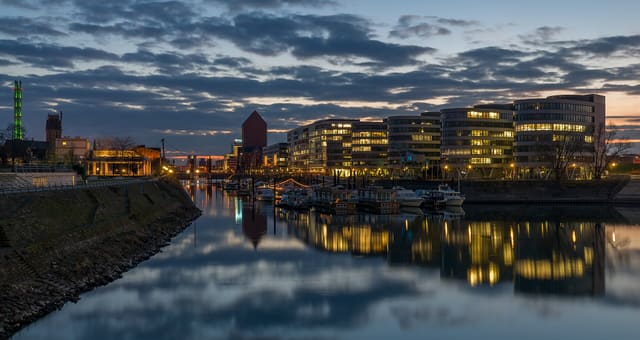
Why Duisburg
A working city, not a postcard - chosen for the engineering, the logistics and the price.
- University of Duisburg-Essen: among Germany’s ten largest universities, with campuses in Duisburg and Essen and an unusually diverse student body
- duisport: the largest inland port in the world and the European end of the China–Europe rail corridor - logistics and supply chain are the city’s core industry
- Engineering with a purpose: nanotechnology, energy systems, water research and metallurgy, next to thyssenkrupp Steel’s headquarters
- The lowest living costs of any city in this guide, with Düsseldorf, Essen and Cologne all within about 30 minutes
Universities & English-taught programmes
The rare German university where you can do the whole engineering bachelor’s in English.
- International Studies in Engineering (ISE): English-taught bachelor’s and master’s in mechanical, electrical, computer and automotive engineering, metallurgy and nanoengineering
- Other English-taught master’s: water science, development and governance, and modern East Asian studies at the Institute of East Asian Studies
- Practice is close by: labs, industrial placements and thesis projects with the port, steel and mechanical-engineering companies next door
- German-taught programmes still need around C1 (TestDaF/DSH) - but ISE means a German engineering degree without German first
Career prospects & ROI
Logistics and heavy industry hire here, and the whole Rhine-Ruhr job market is commutable.
- Industry connections: duisport and the several hundred logistics companies around it, thyssenkrupp Steel, mechanical engineering and the wider Ruhr industry
- Working-student roles and internships in logistics, production and IT are within reach across the entire Rhine-Ruhr region
- Post-study work: an 18-month residence permit to find a job, then a work permit or EU Blue Card - logistics and engineering profiles are in demand EU-wide
- Zero tuition and the lowest rents on this list make Duisburg the cheapest route to a German engineering degree
Cost of living in Duisburg
Estimates for the 2026 academic yearA student in Duisburg should budget around 955 € a month. The heaviest line by far is rent: a room in a shared flat goes for about 350 €, and most land between 280 € and 450 €.
- Room in a shared flat usually 280 € – 450 €
- 350 €
- Food and groceries
- 250 €
- Student travel pass
- 40 €
- Health insurance
- 130 €
- Phone, internet, electricity
- 75 €
- Books, sport, going out
- 110 €
- Monthly total
- 955 €
Ranked 1 of 12 on cost among the cities we cover in Germany, cheapest first.
What things cost here, against the EU
Across the whole shopping basket Germany sits at 109.1, where the EU average is 100 (2024).
EU average = 100
Consumer prices rose 2.3% over 2025.
Prices in Nordrhein-Westfalen
- Consumer prices +2.0% (2025)
- Net rents +1.7% (2025)
- Household electricity 0.44 € per kWh (2025)
Where these numbers come from
The monthly budget is our own estimate, compiled from what student unions, universities and national student services publish. Use it to plan with — it is not a quote.
The price levels, inflation and rent figures are published statistics: Eurostat purchasing power parities and, for German states, the Federal Statistical Office (Destatis).
Success stories
Students who crossed the bridge

“I wasted a year trying alone. After the strategy call I knew exactly which documents I was missing - three months later I had my admission.”Read full story →

“They prepared my visa file so well the interview took ten minutes. They even helped my parents understand the blocked account.”Read full story →

“With the VIP pack I arrived in Finland with my room, bank account and even my airport pickup organised. I just had to study.”Read full story →
What it costs
The cheapest city in this guide by a clear margin.
- Tuition: no tuition fees in North Rhine-Westphalia - only a semester contribution of around €330, including a state-wide transport ticket
- Living costs: about €700–€950/month, the lowest of any city here; student halls and shared flats (WGs) are widely available
- Blocked account (Sperrkonto) for the visa: around €11,900 for the year (about €992/month)
- Part-time work: 140 full or 280 half days a year (roughly 20 hours a week); public health insurance about €130/month
Life, safety & culture
Industrial, multicultural and honest about itself.
- Daily language is German; ISE lectures run in English and the campus is very international, but B1 German is what gets you a part-time job
- An industrial city with green edges: the Innenhafen, the Landschaftspark steelworks-turned-park and the Rhine cycle paths
- Safe in the campus and central districts, with strong public healthcare via statutory student insurance; some outer districts are poor and better avoided at night
- One of Germany’s most multicultural cities, with large Turkish, Arab and African communities and a student body to match
How to apply & the bureaucracy
Applications run through uni-assist or the university’s own portal - start early.
- Apply via uni-assist or the university directly; deadlines are typically 15 July (winter) and 15 January (summer) - ISE has its own earlier deadlines, so check the programme page
- English-taught programmes accept IELTS/TOEFL; German-taught ones need TestDaF or DSH
- Check anabin/DAAD recognition of your secondary certificate - some nationalities need a Studienkolleg first
- After admission, open the blocked account and book the student-visa appointment immediately; allow 6–12 weeks
Read these guides next
Want UniBridgeEurope to do all of this for you?
We take African students from first choice to arrival in Europe: university shortlist, applications, student visa, flights, bank account and housing. Start with a €99 strategy call, or choose the package that comes with an admission guarantee.