Spain · Andalusia
Study in Granada: universities, costs and careers for international students
Granada is where studying in Spain costs the least and feels the most like a student city. The Universidad de Granada was founded in 1531, is one of the largest universities in the country, and has spent years at or near the top of the list of European destinations for Erasmus students - which gives a city of 230,000 people a permanently international student body. Andalusia has also been covering the price of first-sitting credits at its public universities, so the tuition line in your budget is close to zero. The job market is the smallest of the four cities here, and that is the trade-off. Here is what to weigh.
Why Granada
Before the detail, the snapshot - what you actually get by studying under the Alhambra.
- The Universidad de Granada is one of Spain’s largest and oldest universities, with around 60,000 students in a city of 230,000 - the university effectively is the city
- For years the single most popular destination in Europe for incoming Erasmus students, which is why the support for international students here is better than the city’s size would suggest
- Andalusia has been covering the cost of first-enrolment credits at its public universities, so a public degree at UGR costs little beyond administrative fees and insurance. Confirm it still applies for the year you enrol, because it is a regional budget decision
- The lowest student living costs of any major Spanish university city - and Granada’s bars still serve a free tapa with every drink, which is a genuine line in a student budget
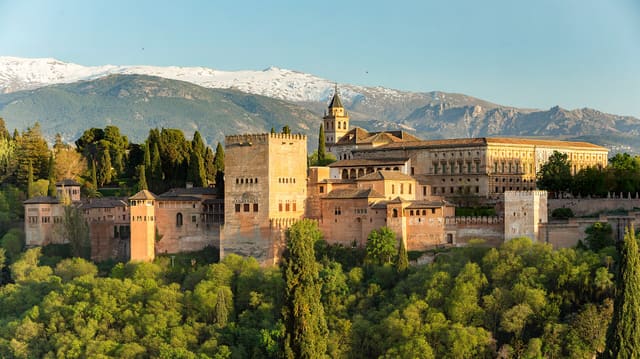
- The Sierra Nevada ski resort is forty minutes from the centre and the Mediterranean coast about an hour, in a UNESCO World Heritage city built around the Alhambra
Universities & popular courses
One university, but a big one. Undergraduate teaching is almost entirely in Spanish; the English-taught options sit at master’s level and in the exchange catalogue.
- Universidad de Granada (UGR): founded in 1531 and spread across five campuses, covering the full range - medicine, pharmacy, the sciences, law, economics, engineering and the humanities
- ETSIIT, its computing and telecommunications school, is one of Spain’s strongest, and UGR has an outsized national reputation in artificial intelligence, soft computing and signal-processing research
- The Faculty of Translation and Interpreting is the best known in Spain, and a natural fit if you already work between three or four languages
- Pharmacy, medicine, physics and Arabic and Islamic studies are the other historic strengths, the last of them tied to the city’s own history
- Curriculum: four-year bachelor’s (grado), one-to-two-year master’s, six-year medicine, with the final-year internship built into most degrees
- Most popular with international students: computer engineering and AI, translation and interpreting, medicine and pharmacy, Spanish language and literature, tourism and architecture
Career prospects & ROI
The smallest job market of the four, with two genuine specialisms - and the strongest cost case in Spain.
- The Parque Tecnológico de la Salud, next to the university hospital, concentrates biomedical, pharmaceutical and health-technology companies alongside research institutes - the main graduate employer cluster in the city
- Granada has a real ICT sector for its size, built around UGR’s computing school: Trevenque, Seven Solutions, NTT Data and a steady stream of AI and signal-processing spin-outs
- IFMIF-DONES, the European particle-accelerator research facility being built at Escúzar outside the city, is a long-term draw for physics and engineering researchers and for the supply chain around them
- Work while you study: the Spanish study authorisation allows up to 30 hours a week of compatible paid work, and in the cheapest student city in Spain that wage stretches further than anywhere else on this list
- After you graduate: the same national 12-month job-search residence permit applies, converting to a work permit on hiring. Many Granada graduates use it to job-hunt in Madrid, Málaga or Seville rather than locally
- The honest trade-off: you will very likely have to leave Granada to find graduate work. What the city gives you is a good degree for almost no tuition and the lowest living costs in the country, which is a strong position to job-hunt from
Cost of living in Granada
Estimates for the 2026 academic yearA student in Granada should budget around 770 € a month. The heaviest line by far is rent: a room in a shared flat goes for about 300 €, and most land between 240 € and 390 €.
- Room in a shared flat usually 240 € – 390 €
- 300 €
- Food and groceries
- 230 €
- Student travel pass
- 25 €
- Health insurance
- 40 €
- Phone, internet, electricity
- 70 €
- Books, sport, going out
- 105 €
- Monthly total
- 770 €
Ranked 1 of 4 on cost among the cities we cover in Spain, cheapest first.
What things cost here, against the EU
Across the whole shopping basket Spain sits at 90.7, where the EU average is 100 (2024).
EU average = 100
Consumer prices rose 2.7% over 2025.
Where these numbers come from
The monthly budget is our own estimate, compiled from what student unions, universities and national student services publish. Use it to plan with — it is not a quote.
The price levels, inflation and rent figures are published statistics: Eurostat purchasing power parities and, for German states, the Federal Statistical Office (Destatis).
Success stories
Students who crossed the bridge

“I wasted a year trying alone. After the strategy call I knew exactly which documents I was missing - three months later I had my admission.”Read full story →

“They prepared my visa file so well the interview took ten minutes. They even helped my parents understand the blocked account.”Read full story →

“With the VIP pack I arrived in Finland with my room, bank account and even my airport pickup organised. I just had to study.”Read full story →
What it costs
The cheapest route to an EU degree that this list contains.
- Public tuition: Andalusia has been covering first-sitting credits at its public universities, so the bill for a grado at UGR is close to the administrative and insurance fees alone. Credits you have to repeat are charged, and the policy is renewed regionally each year - check it for your intake
- Official master’s degrees are charged per credit at Andalusian rates, which are among the lowest in Spain even when they are not covered
- Living costs: budget EUR 600-850 a month. A room in a shared flat runs EUR 250-400, and student-priced menús del día plus the free-tapa custom keep food costs well below the national average
- Scholarships: MAEC-AECID, Fundación Carolina, Erasmus Mundus, the Junta de Andalucía’s own schemes and UGR’s international awards - and UGR runs one of the largest international offices in Spain to help you find them
- Compulsory on top: the visa fee, the TIE card fee and health cover, exactly as elsewhere in Spain
- Note the mismatch: proof of means for the visa is calculated against the national IPREM benchmark, so you must show the same balance as a student going to Madrid even though Granada costs far less to live in
Life, safety & culture
A small, cheap, very international student city with a strong accent and a serious winter for southern Spain.
- Language: teaching and daily life are in Spanish, and the Andalusian accent is genuinely harder for learners than Madrid’s. UGR’s Centro de Lenguas Modernas is one of the biggest Spanish-language schools in the country, and most international students start there
- Granada is small, safe and walkable, with student nightlife concentrated around the university rather than spread across a metropolis
- Long historic ties to North Africa and a large Moroccan and Arabic-speaking community, alongside the permanent Erasmus population - it is an easy city to arrive in alone
- Healthcare: the Andalusian health service covers you once you are registered and enrolled. Do the empadronamiento as soon as you have a lease
- Two practical warnings: Granada sits at 700 metres and its winters are cold, and the local airport is small - Málaga, about ninety minutes away by bus, is the real international gateway
How to apply & the bureaucracy
The standard Spanish process, run through the Andalusian regional admission round.
- Bachelor’s: non-EU school leavers use UNEDasiss to convert their school-leaving certificate into a Spanish admission mark and sit PCE subject exams where the degree is competitive, then apply through the Andalusian distrito único round in June and July
- Master’s: apply directly to UGR, generally between January and June for a September start, with a recognised bachelor’s, transcripts, a CV, a motivation letter and references
- Language proficiency: Spanish-taught programmes ask for B2 Spanish (DELE or SIELE); the English-taught master’s degrees ask for IELTS 6.0-6.5 or TOEFL iBT 79-90
- Legalise and translate your documents before you leave home - apostille or consular legalisation, plus a sworn translation by a traductor jurado
- After acceptance, apply for the student visa at the Spanish consulate, then register your address and apply for the TIE within 30 days of arrival. UGR’s international office handles a very large volume of these every September and is used to walking students through it
Read these guides next
Want UniBridgeEurope to do all of this for you?
We take African students from first choice to arrival in Europe: university shortlist, applications, student visa, flights, bank account and housing. Start with a €99 strategy call, or choose the package that comes with an admission guarantee.